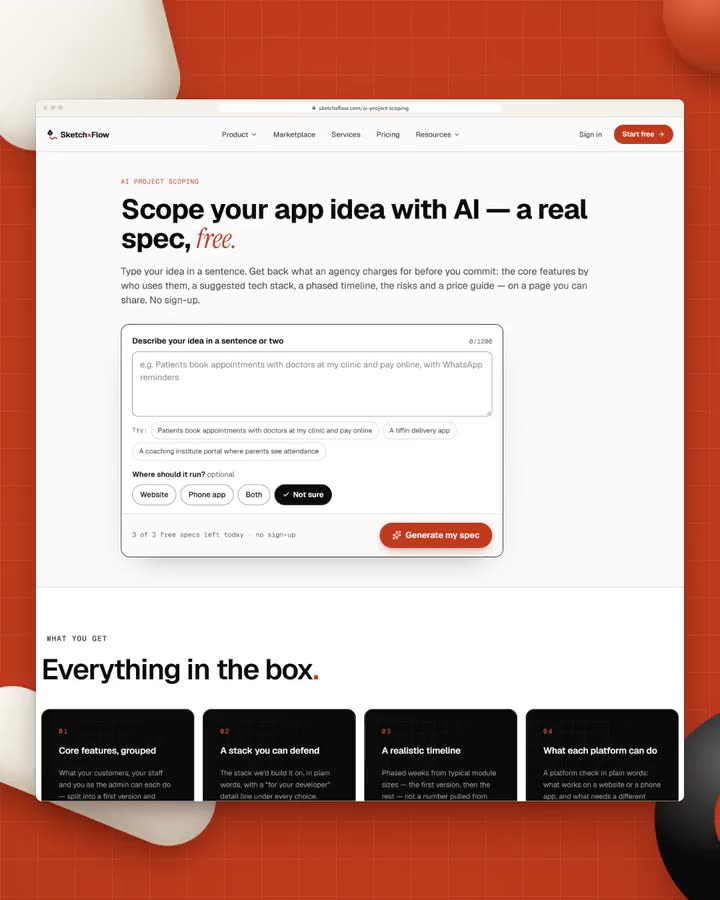
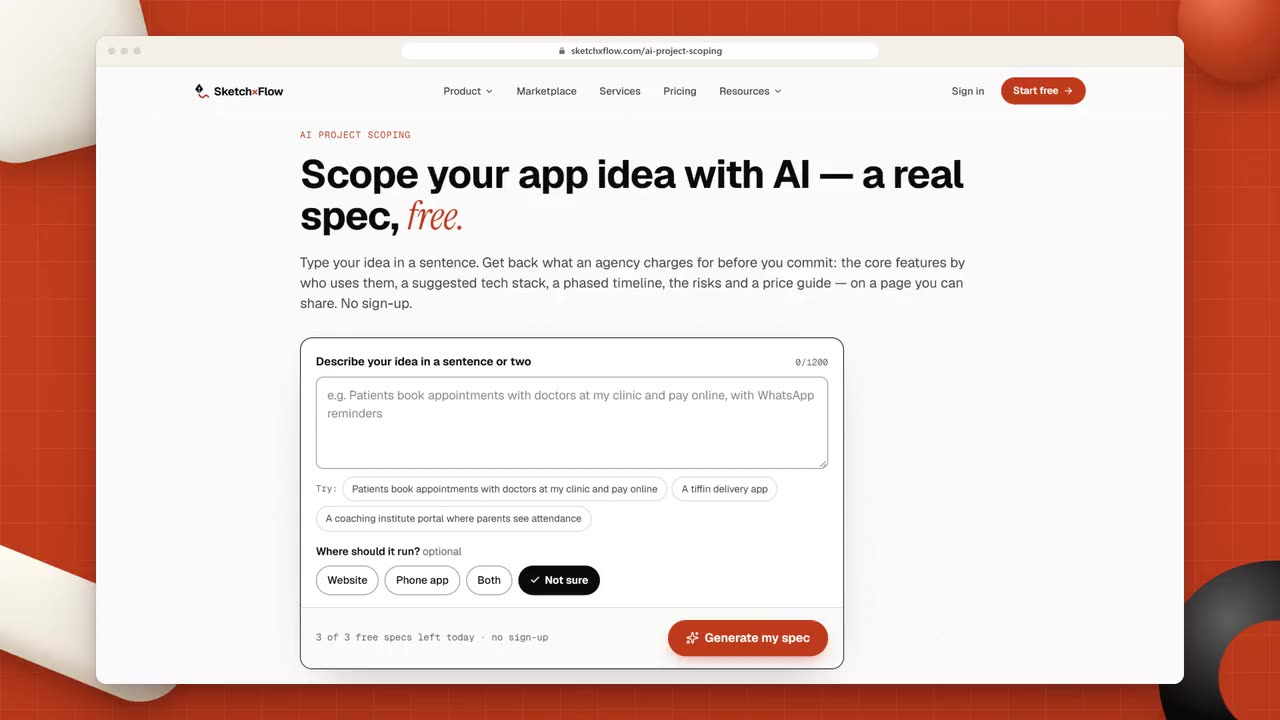
Scope your app idea with AI — a real spec,free.
Type your idea in a sentence. Get back what an agency charges for before you commit: the core features by who uses them, a suggested tech stack, a phased timeline, the risks and how it would be priced — on a page you can share. No sign-up.
Everything in the box.What you get, shipped and working today.
- 01
Core features, grouped
What your customers, your staff and you as the admin can each do — split into a first version and version 1.
- 02
A stack you can defend
The stack we'd build it on, in plain words, with a “for your developer” detail line under every choice.
- 03
A realistic timeline
Phased weeks from typical module sizes — the first version, then the rest — not a number pulled from the air.
- 04
What each platform can do
A platform check in plain words: what works on a website or a phone app, and what needs a different approach.
How it works.4 steps, start to finish.
- 01
Type your idea
One or two sentences: what it does and who it's for. Pick where it should run, or leave it to us.
- 02
Our consultant drafts it
The same AI consultant our clients use writes the full requirements, then checks what each platform can actually do.
- 03
Get a spec you can share
Features by who uses them, a suggested stack, a phased timeline, risks and the questions to settle — on its own link.
- 04
Build it, if you like
“We can build this” turns the spec into a real project with the requirements already written. Engineers build it.
Answers, straight.8 answers, each complete on its own.
Still stuck? Write to support@kriyaxlabs.com and a person answers.
Yes. Describe your idea and you get a full spec on its own shareable page, with no sign-up. Anyone can make three specs a day. Signing in is only needed if you want us to build it.
A project summary, who it is for, the core features grouped by who uses them (customers, staff, admin) and split into a first version and version 1, the platforms with a plain-words check of what each can do, a suggested tech stack with a detail line for your developer, a phased timeline, the risks and unknowns, and how it would be priced.
It depends on what you need. After a free 30-minute call you get a written plan with a fixed price for the agreed scope, priced per module and never per hour, and nothing is committed until you accept it.
It is a rough guide built from typical module sizes, not a promise. It shows the first version and then the rest in weeks. The proposal after your requirements are finalised fixes the scope, the price and the dates.
The stacks we build in: Next.js and React for the web, Flutter or React Native for phone apps, a Python or Node server, PostgreSQL or MongoDB, all hosted in a cloud account in your name. Every choice has a plain explanation and a detail line for a developer.
You sign in with Google in one click and the spec becomes a real project: the requirements document is already drafted from your idea, and our consultant picks up with a few questions. Nothing is charged; you book a free call and see the price before you accept anything.
Each spec lives on its own unguessable link that search engines are told not to index. Share it with whoever you like. We never show your email or account on it.
Anything clearly harmful or illegal, and the kinds of product we don't build: games, AR/VR and blockchain. For those the tool says so instead of writing a spec.